2026 New Jersey Academic Libraries Conference
Date/Time: Friday, January 9, 2026; 8:30 am – 4:30 pm
Location: Liberty Hall Academic Center, Kean University, 1003 Morris Ave Building #2, Union, NJ 07083
Directions & Parking: Park in the LHAC Lot or the STEM Lot | Campus Map PDF | Directions
PDF Full Program Schedule | One Page Abridged Program
Conference Photos (Email alison.cole@valenj.org if you have photos to add!)
Sponsors
Schedule
- 8:30 am – 9:45 am: Registration, Breakfast, & Poster Sessions
- 8:30 am – 9:45 am: Exhibitor Networking
- APA, Clarivate, EBSCO, IEEE, JSTOR/Ithaka, Kanopy/OverDrive, LexisNexis, Pressbooks, Research Solutions, Springer Nature, ThirdIron
- LibraryLinkNJ, New Jersey State Library, VALE Outreach Committee
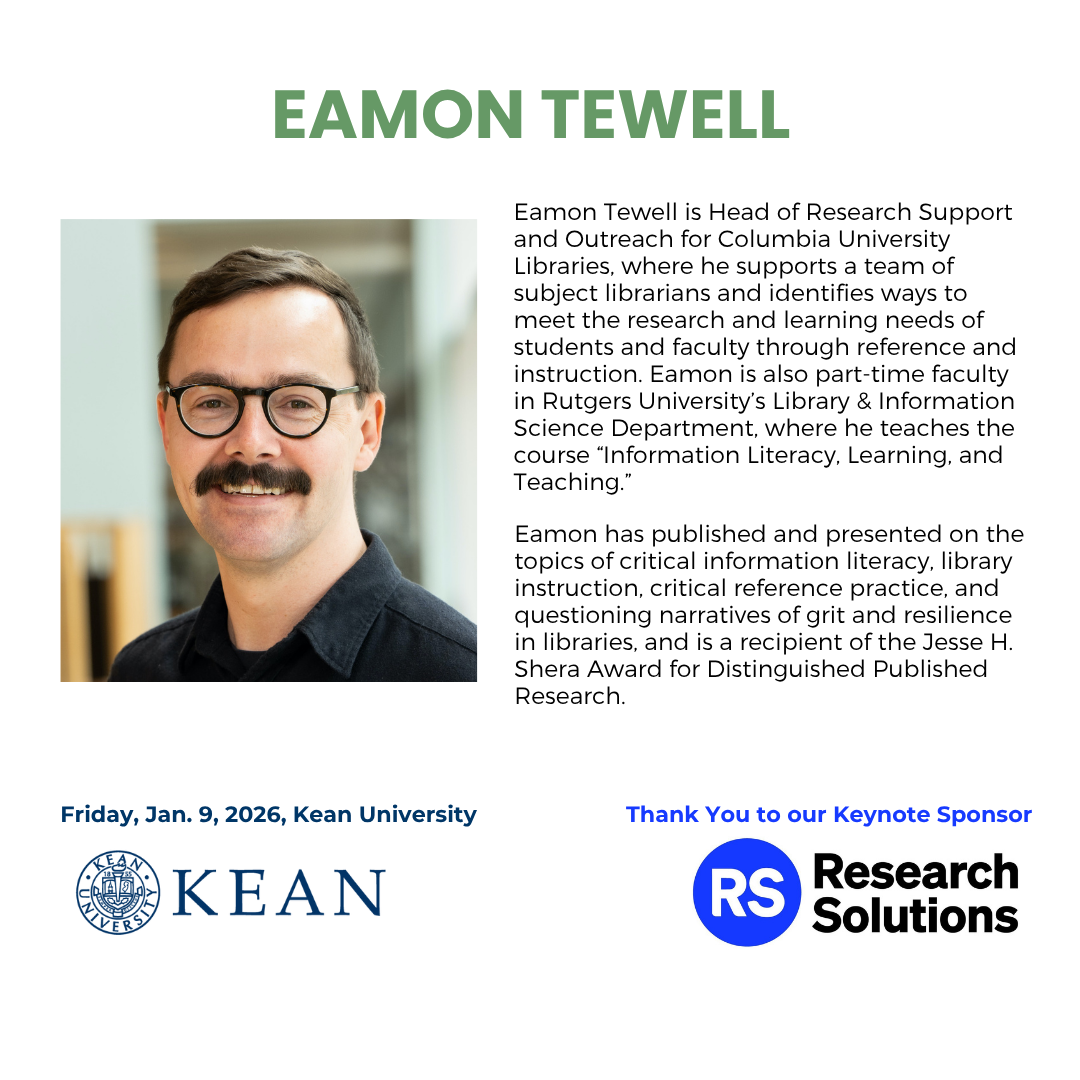
- 10 am – 11 am: Welcome & Keynote – Sponsored by Research Solutions
- 11:10 am – 12 pm: Breakout Session I
- 12 pm – 1 pm: Lunch & Organizational Updates
- VALE – Evelyn Frangakis, Executive Committee Chair
- New Jersey Library Association – Brett Bonfield, Executive Director
- New Jersey State Library – Maria Baratta, Director, New Jersey State Library Information Center
- New Jersey Association of School Librarians – Ewa Dziedzic-Elliott, Past President
- LibraryLinkNJ – Ralph Bingham, Executive Director
-
New Jersey Academic Librarians – Megan Dempsey, President
- 1 pm – 1:30 pm: Exhibitor Networking
- 1:45 pm – 2:35 pm: Breakout Session II
- 2:45 pm – 3:35 pm: Breakout Session III
- 3:45 pm – 4:30 pm: Post Conference Networking/Coffee & Tea Social
*Updates & Cancellations*
- B12. Librarians as Leaders: Building AI Literacy has been cancelled
-
LTO2. b. Graduate Student Success — What does it look like? has been cancelled
Keynote Presenter:
Poster Sessions (8:30 am – 9:45 am)
P01. Inclusive Learning Through OER: Beyond Cost Savings
Rhonda Marker, Rutgers, The State University of NJ
This poster explores how Open Educational Resources (OER) support transformative teaching practices that go beyond affordability to embed diversity, equity, inclusion, and accessibility (DEIA) into course design. It highlights how adopting and adapting OER and other affordable materials can reflect diverse student backgrounds, learning styles, and levels of preparation; integrate culturally relevant content, active learning, and interdisciplinary approaches; and increase engagement. OER also offer flexibility to incorporate current events and emerging research. Through real-world examples across disciplines, this poster demonstrates how librarians collaborate with faculty to create inclusive, responsive learning environments.
P02. Building Community and Advancing Practice: The NJAL Medical Librarians SIG
Maria Deptula, Rutgers, The State University of NJ; Mina Ghajar, Rutgers, The State University of NJ; Emily Cerri, Seton Hall University; Nicole Potdevin, Fairleigh Dickinson University
Established in January 2025, the NJAL Medical Librarians Special Interest Group supports New Jersey librarians working in health sciences education and research. Open to those serving allied health, nursing, and medical programs, the SIG fosters collaboration, professional development, and peer learning. Focus areas include health sciences databases, instructional strategies, systematic reviews, AI in healthcare, and emerging trends. Whether seasoned or new to the field, members benefit from networking and shared resources. This poster introduces the SIG’s mission, early initiatives, and future plans, encouraging broader participation and statewide engagement.
P03. 2026 NJLA + NJASL Conference: A New Chapter: Imagine the Possibilities
Alyssa Valenti, Raritan Valley Community College
Please join the NJLA and NJASL at the annual conference in Atlantic City February 17-19, 2026. This is an exciting year for the conference as it is a year of firsts – first year to be co-located with NJASL, first year in a new location; and the first year to be held in February.
There will be many programs of interest to academic librarians with the exciting addition of NJASL content which scales to academic libraries. Visit the poster to use the QR code to register for the conference.
P04. AI Tool Evaluation for Use in Academic Libraries
Theresa Agostinelli, Brookdale Community College; Maria Deptula, Rutgers University; Justin Savage, Montclair State University; Suzanne Kosempel, County College of Morris; Joanne Dera, Rutgers University; Heather Smith, Mercer County Community College
This poster will share the formation story, structure, and outcomes of the NJAL AI SIG and its Community of Practice. The poster will provide insights into how to build similar initiatives, secure funding, and foster meaningful engagement around emerging technologies in academic library environments.
Neil Grimes, William Paterson University; Samuel Fancera, William Paterson University
This poster session presents findings from a qualitative study on how partnerships between academic libraries and P–12 schools can advance professional development, information literacy, and educational innovation. Drawing on perspectives from library administrators and superintendents, the study highlights opportunities for collaboration in response to New Jersey’s information literacy law, including educator training in IL, EdTech, AI, and project-based learning. The presenters offer practical models such as flexible delivery formats, certification programs, and scalable funding approaches that position academic libraries as key partners in strengthening teacher capacity, curriculum integration, and student preparedness for college and careers.
P06. Understanding Faculty Engagement with Transformative Publishing Agreements
Benjamin Saracco, Cooper Medical School, Rowan University; Andrea Shipper-Goldstein, Cooper Medical School, Rowan University; Marlowe Bogino, ChristianaCare; Daniel Kipnis, Rowan University
This poster session presents a mixed-methods study exploring how newly implemented transformative “read and publish” agreements have influenced faculty publishing behaviors and perceptions of open access at a U.S. university. Led by a team of academic faculty librarians, the research examines how these agreements shape journal selection, attitudes toward open-access quality, and departmental views on publishing prestige. Preliminary findings reveal growing awareness and engagement with open access alongside persistent concerns about journal reputation.
P07. NJAL Access Service Committee: Let’s Circulate!
Madel Tisi, Ramapo College; Bethany B. Sewell, The College of New Jersey
The Access Services Committee provides a collaborative forum for NJ Access Services practitioners to share best practices, address mutual challenges, and connect quarterly through virtual meetings and an annual in-person gathering. This poster describes our activities and collaborative research project. We invite everyone in Access Services to join our fun group!
P08. Leading with Literacy: How Libraries Can Inspire Students to Read Again
Kevin Handeli, Montclair State University; Theresa Corbin, Montclair State University
During Student Appreciation Week—coinciding with Banned Books Week—our libraries launched “We Respect Your Right to Read: Blind Date with a Banned Book,” a twist on the classic Blind Date with a Book program. Students selected wrapped books labeled with a “report card” only stating why the book was banned. This engaging, week-long activity engaged students in reading, exploring diverse perspectives, and reflecting on the value of unrestricted access to information. By blending fun with intellectual exploration, the program bridged entertainment and enrichment, encouraging today’s high screen-time generation to rediscover the joy of reading.
P09. Exploring AI in Academic Libraries: The NJAL AI Special Interest Group
Theresa Agostinelli, Brookdale Community College; Joe Louderback, DeVry University; Maria Deptula, George F. Smith Library of the Health Sciences, Rutgers University; Jia Mi, The College of New Jersey
This poster highlights a New Jersey academic special interest group focused on artificial intelligence. The group hosts open meetings several times a year for librarians, staff, and educators to learn emerging trends, share best practices, and present on innovative uses of artificial intelligence in library services and research. Attendees can learn about previous sessions, discover how to join future meetings, and contribute new ideas. Participation is flexible—anyone may attend as many or as few sessions as they wish, with no ongoing commitment required.
P10. Creation of Interactive and Real Time Dashboard to Communicate Library Impact
Yongming Wang, The College of New Jersey
As libraries face challenges related to budgets, staffing, and usage, clearly demonstrating their value is essential. This presentation introduces a pilot project to develop a real-time library dashboard that consolidates data on collections, resource usage, reference and instructional services, visitor activity, and website traffic. By integrating these metrics into a single platform, libraries can gain actionable insights into usage patterns, resource effectiveness, and service impact. Real-time data supports better decision-making, strengthens funding requests, and enhances the user and staff experience, offering a comprehensive, data-driven view of library operations for stakeholders and the community.
P11. The NJAL Assessment Committee: More than Just Information Literacy
Christina Connor, Ramapo College; Eric Jeitner, Stockton University
Assessment is often associated with information literacy. However, libraries can provide a wealth of data in various areas to lead the way to support and promote services, as well as empower each other to advocate internally and externally for our role in the academic community/experience. The NJAL Assessment Committee strives to bring together librarians as partners in these initiatives – whether survey novices or veteran data collectors – to explore assessment from various perspectives. Utilizing a variety of methods to approach discussions, from workshopping to critical readings to guest speakers who specialize in member-selected topics, we welcome all interested. Since assessment can cover all aspects of librarianship, the Committee also collaborates with other NJAL Committees to broaden discussion and share ideas and practices.
Ann Marie Latini, Rutgers, The State University of NJ; Zara Wilkinson, The State University of NJ
Academic libraries are continually exploring ways to support students beyond traditional academics. This poster highlights the development of three innovative circulating collections: museum passes, board games, and calming kits. These collections are designed to promote student well-being, inclusion, and engagement. Attendees will gain practical insights into launching similar initiatives, including implementation strategies, stakeholder collaboration, and effective promotion.
P13. NJAL Reference & User Education Committee
Joe Louderback, DeVry University; Kaitlyn Clohosey, Felician University
The Reference & User Education Committee is dedicated to the outstanding provision of library user instruction and reference services. This poster provides a summary of the committee’s activities. A brief overview of recent and planned discussion topics and initiatives, including the Summer Workshop, are outlined. We also share information on how to get involved in this active committee.
P14. NJAL eResources Committee
Christina Getaz, Caldwell University; Bill Vincenti, Montclair State University
This poster reports on the ongoing work of the NJAL eResources Committee and invites interested attendees to get involved with our committee.
Breakout Sessions
Breakout Session I – 11:10 am – 12:00 pm
B01. Robots in the Catalog: Best Practices for Cataloging AI-Generated Works
Michelle Echols & Catherine Oliver, Montclair State University
Come see us talk about how we fight robots every day by finding new ways to name and shame them. They could have lied to our patrons, too, if it weren’t for us meddling catalogers! We will talk about how different libraries catalog AI-generated materials and how national and local best practices for describing them often conflict with how our catalogs are structured. We will conclude by discussing some of the dangers presented by the generative AI information environment.
B02. Reimagining the K-12 Collection
Ewa Dziedzic-Elliott, Bethany Sewell, & Yuji Tosaka, The College of New Jersey
After an in-depth analysis of the K-12 Model Library, the Gitenstein Librarians are collaborating to reimagine that collection. The new arrangement will separate the current collections into appropriate reading levels with additional sections for graphic novels, biographies and foreign language books. Presenters will share their contributions to the creation of the plan and the progress of its implementation so far: The Education Librarian will explain the concept and justification in context of the TCNJ’s programs and appropriate standards and guidelines; The Cataloging and Metadata Librarian will explain the complexities of cataloging considerations, including work analyzing and customizing legacy MARC records to better describe and separate the collections; The Access Services Librarian will discuss physical space planning considerations and managing the workflow of reshelving newly recataloged and relabeled materials. The presenters will emphasize the importance of collaboration and communication across departments to increase staff knowledge and skills and ensure a smooth transition
B03. Inspiring Graduate Student Authors: A Collaborative Community Approach
Catherine Baird, Emily Cepin, & Alicia Remolde, Montclair State University
This session will introduce participants to a case study on the implementation of a Graduate Student Journal Article Writing Group and contextualize this within the existing literature. Graduate students can benefit from targeted programming to develop their academic research and writing skills, topics which may receive a varying amount of attention in their formal degree programs. The goal is to create community amongst graduate students from different disciplines, and to provide accountability, academic support, and structured activities to strengthen their academic identities, research and writing skills.
Ann Hoang, Annie Chatterjee, Aaron Crandall, & Yash Chaudhary, New Jersey Institute of Technology
Discover how NJIT is transforming scholarly communication by breaking down paywalls and building partnerships that advance open access in STEM research. Many institutions still rely on costly subscription models that limit access and strain budgets. This session showcases NJIT’s innovative Read and Publish agreements and transitional contracts that balance cost, equity, and global impact. Despite growing interest in open access, fewer STEM institutions have demonstrated shared, practical, and replicable strategies to make it both sustainable and equitable. Learn how NJIT reimagined its publishing model – empowering faculty and redefining collaboration between libraries and publishers to expand access and accelerate discovery.
Joyce DeStasio, Stockton University (moderator); Gary Marks, William Paterson University; Sam Wittenberg, Ramapo College of New Jersey; Richard Jutkiewicz, Rutgers; Ermira Mitre, Rutgers
Marketing and outreach are powerful tools for leadership, partnership, and empowerment in academic libraries. This panel will highlight innovative initiatives from multiple institutions that demonstrate how libraries lead campus conversations, build partnerships across departments and communities, and empower students to thrive. Panelists will share strategies such as collaborative programming with campus partners, inclusive outreach campaigns that amplify diverse voices, and creative marketing approaches that strengthen library visibility and impact. Attendees will gain practical ideas for advancing student success, supporting faculty, and positioning the library as a leader and partner in higher education.
B06. Information Literacy 3.0: Student Empowerment for Lifelong Learning in the Age of AI
Maria Burton-Conte, Jodi Shelly, & Danianne Mizzy, Felician University
This session presents a comprehensive, collaborative approach to developing a one-credit Information Literacy course into a three-credit model, empowering lifelong learners. The presenters will highlight how a vision-board design process, comparative analysis of peer syllabi, literature review, and benchmarking of OER assets and assessments informed weekly themes, learning outcomes, and active-learning assignments. The design incorporates metacognitive reflection, concept mapping of the information ecosystem, and a capstone “Personal Information Literacy Plan.” AI tools, including ChatGPT, were leveraged to support idea generation, scaffolding, and assessment design. Attendees will gain replicable frameworks for course development, innovation, and empowerment in the age of AI.
Yingting Zhang, Rutgers, The State University of NJ
Academic librarians have played a critical role in supporting evidence synthesis projects, including systematic reviews (SRs), scoping reviews (ScRs), and other structured reviews. This breakout session reflects on a decade of extensive SR services that the presenter provided to the health sciences researchers at Rutgers University through consultations and collaboration. The presenter shares the SR projects they have consulted and collaborated on with researchers over the past decade, discussing the roles undertaken, practice guidelines adhered to, tools utilized, information sources consulted, and the lessons learned throughout this experience. The session concludes with recommendations for providing SR services in academic libraries.
LT01. Lightning Talks
a. AI Meets UDL 3.0: A Chatbot for Designing UDL 3.0 Lesson Plans
Madeline Ruggiero, Queensborough Community College
For many schools implementing Universal Design for Learning (UDL) is already a driving force for designing engaging and accessible learning spaces.This session will introduce you to LUDIA, the no cost AI-powered UDL thought partner. During this brief time I will demonstrate how to use LUDIA to create lessons for your one-shots that align with the updated UDL 3.0 framework. The latest modifications to the UDL framework will also be discussed.
b. AI in Action: Creating Instructional Videos for Libraries
Mei Ling Lo, Rutgers, The State University of NJ
Librarians often use short videos to help students learn, but making these videos takes time and technical skills. Artificial intelligence (AI) video creation tools such as Heygen can make this work easier. They turn written scripts into videos with avatars and voices. Librarians can focus on instructional content. This lightning talk will show how AI can help create engaging learning materials for library users. It will also discuss the limits of this approach and encourage librarians to think carefully about how to use AI to enhance library instruction.
Breakout Session II – 1:45 pm – 2:35 pm
B08. Developing a Critical Information Literacy Rubric for a New General Education Curriculum
Bonnie Fong, Catherine Baird, Drew Wallace, Michelle Echols, Montclair State University
As Montclair State University developed a new general education curriculum, librarians collaborated with co-directors of the curriculum to embed critical information literacy (CIL), now a core value identified as “Educated Citizenry.” In Fall 2024, all librarians participated in developing a CIL rubric to support assessment in library sessions and the general education curriculum, plus curriculum mapping. This presentation highlights our collaborative rubric development process and shares the resulting product. We will also discuss our leadership role, being the first to create a rubric for a core value in the general education curriculum, advancing institutional goals for accreditation and student success.
B09. Empowering Minds & Bridging Gaps: The Crucial Role of Information Literacy
Ewa Dziedzic-Elliott, The College of New Jersey; Brenda Boyer, Rutgers
The demand for information literacy skills is at an all-time high. For high school students to become ready for college as well as for their civic life, these skills must be recognized, planned for, and well instructed. School librarians are looking for instructional solutions to meet this demand. Recent research points to existing gaps in information literacy instruction as well as corresponding instructional design solutions. Discoveries about the research strategies students learned in high school and served them well in college hold implications for instructional design of information literacy skills in high school. The presenters will provide an organized taxonomy of information literacy skills as well as practical recommendations for instructional designs. See how this important evidence provides a roadmap for designing collaborative inquiry experiences that include rigorous information literacy and research skill instruction.
Richard Donegan, New Jersey Institute of Technology; David Frank, Seton Hall University; Emily La Jeunesse, Drew University; Linda Salvesen, William Paterson University; Bethany Sewell, The College of New Jersey
In 2025, three New Jersey institutions—NJIT, The College of New Jersey (TCNJ), and William Paterson University (WPUNJ)—collaborated as part of the VALE Consortium’s Rapido POD to implement Ex Libris’s next-generation resource sharing platform. Seton Hall University joined the POD later in the process, bringing a unique perspective as it currently utilizes the Folio ILS. Drew University had already implemented Rapido with Folio, further enriching the consortium’s collective expertise and providing valuable insights on cross-platform integration. This session will share how the VALE Rapido POD was formed, the planning and coordination that guided implementation, and the practical experiences of each campus. Topics will include system configuration, integration with Alma and Primo, workflow redesign, staff training, and communication with stakeholders.
The session will also explore the consortium-level benefits of implementing Rapido within a POD, including opportunities to deepen collaboration across institutions, improve turnaround times, and expand equitable access to scholarly resources for students and faculty. Attendees will gain practical takeaways for launching or joining a Rapido POD, along with lessons learned about how shared strategies can amplify impact, streamline operations, and advance resource sharing at scale.
B11. Bridging Boundaries: Libraries as Catalysts for Interdisciplinary Research
Darren Sweeper, Montclair State University
This presentation examines how libraries and librarians can facilitate interdisciplinary research by connecting diverse resources, guiding scholars across disciplinary literatures, and fostering collaborative spaces. Emphasizing librarian expertise in data management, information literacy, and scholarly communication, it highlights their role as research partners and knowledge brokers. Through tools, case studies, and future opportunities, participants will gain strategies to position their libraries as hubs of cross-disciplinary collaboration and innovation.
B12. Librarians as Leaders: Building AI Literacy [*Cancelled*]
Heather Dalal & Robert Lackie, Rider University
At Rider University, the library has become a hub for AI literacy and campus conversations on AI through workshops, collaborations with Career Development and Success, asynchronous certificate modules, and a proposed credit-bearing course. Librarians are increasingly recognized as AI experts, guiding students, faculty, and staff in both critical dialogue and skill development. This session highlights Rider’s experience while offering adaptable strategies for other institutions to foster AI literacy and conversations at their campuses.
B13. Beyond the Stacks: Pop-Up Libraries as Outreach and Instruction
Dylan Vetter & Sara Imranyi, Middlesex College
We piloted an engaging pop-up library in collaboration with the English Department for a Get Lit(erature) conference held during Banned Books Week. Our pop-up featured challenged titles for checkout, interactive elements that sparked engagement, and links to our online materials. At other campus-wide events, we employed additional “hooks” to start conversations about library services with students. In this breakout session, we’ll share our planning and implementation strategies, highlight the interactive components that made the events successful, and share other campus partnerships that were born from initial pop-ups. We invite attendees to share their own experiences with this style of outreach.
LT02. Lightning Talks
a. Hack Experiential Learning: Creating Student Success through a UX Library Competition
Zoe Mooneyhan, Luci Parrish, & Kennedy Jones, New Jersey Institute of Technology
This presentation will provide an overview of our experiences adapting an event, NYU’s Hack Dibner, to NJIT’s Van Houten Library and its student population. We will discuss the planning, implementation, and assessment of “Hack Van Houten,” a semester-long proof-of-concept competition where students used their skills to improve library user experience with technology. This competition offered undergraduates an opportunity to apply their academic skills in a practical, problem-solving environment while competing for monetary prizes and creating portfolio-enhancing projects. Special attention will be given to how this event promoted student success on our campus, and to our collaborations with several university departments.
b. Graduate Student Success — What does it look like? [*Cancelled*]
Jill Lagerstrom, New Jersey Institute of Technology
How is graduate student success different from undergraduate student success? In this lightning talk we will describe a new program at NJIT to provide graduate students the research skills they need to succeed at each step along the path to completing their dissertation. This program was developed in collaboration with the Graduate Studies Office and Graduate Student Association to provide a diverse group of learners a scaffolded approach that supports them at point-of-need.
c. Library Displays as Instructional tools
Colleen Fischer, Fairleigh Dickinson University
If books are not flying off your displays or you are struggling to engage students on all aspects of the ACRL Framework, incorporating instructional elements into your displays can be a good way to: show off the diversity of your collection, articulate the library’s instructional role to community members and address small gaps in information literacy classroom instruction. At the very least, this presentation will spark creativity and display ideas.
Round Tables
RT01. It Takes a Village: Improving Access to Archival and Unique Collections through Collaboration
Moderators: Kimberly Lynch & Christina Getaz, Caldwell University
This round table will promote discussion about projects to make archival and unique resources more findable and accessible to our campus communities. We will focus on collaboration around technological strategies to do this. This conversation is motivated by our work at a small university library where we frequently partner with university IT and vendors, but often have to do a lot of work to explain what we need.
- Have you worked on successful or unsuccessful projects to increase findability of archival collections recently?
- How have you collaborated with campus IT, vendors, and others to make this happen?
- What relevant capacity do you have (or not have) within the library?
RT02. Reference & Research Services in an AI-Enhanced World
Moderators: Joe Louderback, DeVry University; Sara Toro, Princeton University
Artificial intelligence is seemingly ubiquitous in the world of research, with common search engines and even subscription databases adding AI as a default option. While still relatively rare, AI chatbots are being introduced at some academic institutions as the first level of reference service. Students are adopting AI for many academic tasks, not all of them in accordance with the spirit of academic integrity. AI is increasingly discussed in library instruction sessions, but how are librarians navigating AI’s presence in the full spectrum of researcher-facing interactions, from reference questions to research consultations at the service desk and beyond?
- How are academic reference librarians reckoning with AI-augmented search in common search engines when working with students? Which (if any) rubrics or models for AI prompting are you sharing with students during the reference transaction?
- How are you evaluating AI tools for potential recommendation? What criteria—such as transparency, bias mitigation, accessibility, or integration with existing systems—are guiding your assessments?
- How do you respond when a researcher presents AI-generated citations or information that turns out to be unverifiable? What approaches have you found effective for guiding users back to credible sources while encouraging critical use of AI outputs?
Breakout Session III – 2:45 pm – 3:35 pm
B14. Empowerment Through Understanding: AI Research Tools and the Data that Powers Them
Justin Savage, Catherine Baird, & Jacob Bilek, Montclair State University
Artificial intelligence is transforming how scholars discover and engage with research. This session explores how common AI research tools draw on scholarly corpuses such as Semantic Scholar, OpenAlex, and Crossref to provide literature searching and analysis capabilities. Attendees will gain a deeper understanding of how these platforms aggregate, analyze, and visualize scholarly data to support literature reviews, topic exploration, and evidence synthesis. Emphasizing librarian leadership in AI literacy and critical AI adoption, this session aligns with the conference theme by showcasing how libraries can empower users and advance success in research and learning.
B15. Game On! Creative Gamification in the Library
Caitlin Connelly, Adele Conway, & Christine Stevenson, Georgian Court University
Gamification enhances the learning experience and empowers students to explore the library in new and innovative ways. The opportunities to introduce it in your library span from the simple to the complex. This presentation will explore the “why”s of gamification and will offer a variety of resources for librarians to consider in their own gamification goals. We will discuss the creation of the video game we debuted for our library’s New Student Orientation, from ideation to development to rollout, including our partnership with the General Education program. We will also give a demonstration of our video game and offer participants the chance to play it themselves.
B16. Hands on History: Empowering Students and Developing Partnership through Experiential Learning
Christina Connor, Ramapo College
Archives and special collections have the ability to play a crucial role within higher education. Partnerships with special collection librarians can create pathways for students to engage with historical materials that shape their educational experiences and have the potential to transform perspectives and their worldview. In this session, the presenter will showcase efforts made using one of the library’s unique special collections to provide hands-on learning opportunities that serve both pedagogical initiatives as well as to engage community partners to participate in and support these initiatives. The presenter stresses the need to develop these partnerships in order sustain and grow similar endeavors. Combining traditional archival practices with new innovative digital tools, the presenter highlights that these efforts are critical to advancing higher education by fostering skills that builds upon past scholarship, ensures academic rigor, and fosters a learning environment where the past informs the future.
B17. Between Innovation and Integrity: Evaluating AI in Library Databases and Discovery Tools
Jia Mi, The College of New Jersey
As more library databases incorporate artificial intelligence, librarians are presented with new opportunities and challenges in their support of research and learning. This session examines how electronic resources librarians can play a critical role in evaluating AI-driven features and their implications for access, transparency, and privacy. The presentation offers practical approaches for assessing emerging tools and communicating balanced insights to peer librarians, students, and administrators. By creating awareness and a forum for conversation about the presence of AI in library databases, librarians can empower their communities to explore these technologies responsibly, collaboratively, and with integrity.
B18. Building Equity Together: Tools from New Jersey’s Statewide EDI Library Initiative
Ralph Bingham & Mi-Sun Lyu, LibraryLinkNJ; Ali Cole, VALE
This session introduces the New Jersey Statewide EDI Strategic Roadmap for Libraries, a coordinated initiative providing tools and resources to support equity, diversity, and inclusion across library organizations. Attendees will gain an understanding of available resources, access points, and collaborative structures that support EDI efforts statewide. This session equips libraries with actionable knowledge to begin exploring and adapting strategies that can strengthen their leadership, partnerships, and campus impact.
B19. Teaching Students to Doubt the Machine: A Critical Look at AI Evaluation Pedagogy
Sharon Yang & Robert Lackie, Rider University
This presentation explores the challenges posed by AI-generated content and examines how librarians currently teach the evaluation of AI output. The presenters collected data from 60 academic libraries. The findings highlight the progress made by both librarians and the tech industry in addressing hallucination issues and discuss the metrics, criteria, and tools used to evaluate AI-generated content—assessing their overall effectiveness. The central question remains: can we truly teach AI output evaluation within our information literacy programs?
B20. Curating Career Competencies Across the Curriculum: Information Literacy at the Crossroads
Alyssa Valenti, Raritan Valley Community College
Many institutions are seeing a need to demonstrate how course learning outcomes directly transfer to the workforce in ways that emphasize skills-based, essential learning including critical thinking, and professionalism to name a few. Raritan Valley Community College recruited faculty from across the college to envision a way that NACE competencies for career readiness could be embedded throughout the curriculum. Information literacy highlights these skills and aligns competencies across disciplines. Join this session to learn how one librarian was involved in institutional conversations from the beginning and implemented several of the eight NACE competencies throughout information literacy instruction sessions to increase career readiness knowledge.
LT03. Lightning Talks
a. Evolving Libraries: People and Technology Collaborating to Build Communities
Maya Gervits, New Jersey Institute of Technology
As higher education continues to evolve, meaningful collaboration between academic libraries and faculty has become a strategy for enhancing student engagement, developing research skills, and supporting academic success. Libraries serve as hubs for educational experiences that extend beyond the classroom. By demonstrating adaptability, initiative, and recognition as co-creators within the academic community, libraries position themselves as trusted partners and collaborators. The IT Revolution has not replaced libraries; instead, it has expanded their roles, requiring deeper collaboration. Beyond their traditional functions, libraries are now exploring new technologies, hosting discussions, and acting as facilitators and recorders of ongoing curriculum development. Collaboration between libraries and faculty helps create new content, enhances student engagement, and fosters stronger community bonds. The presentation will highlight several technology-driven initiatives, including the Digital Archive of Newark Architecture and the use of Omeka and Scalar platforms across the university. It will showcase the integration of mixed reality and holographic devices in studio projects, along with other creative outcomes displayed in virtual and traditional exhibitions hosted by the library. The focus will also be on collaboration in integrating information literacy, maintaining the Digital Scholarship Lab and Material collection, and implementing programs that promote student participation and foster a sense of belonging.
b. Leading with Care: Person-Centered Appraisals as a Lever for Culture Change in Academic Libraries
Satasha Williams, William Paterson University
Academic libraries change through everyday conversations, not just plans. This session reframes performance appraisal as a simple, people-first leadership ritual that strengthens culture and advances student success, faculty research, and campus initiatives. Grounded in Self-Determination Theory and the Competing Values Framework, we share a 20-minute “mini-appraisal” cadence, three ready-to-use tools (win log, barrier backlog, notes template), and a light evaluation plan pairing quick staff pulses with service metrics. Attendees leave with practical steps to embed gains in SOPs and onboarding—turning evaluation from paperwork into empowerment.